Pages

Total Pageviews

Showing posts with label manchester united. Show all posts

Thursday, May 16, 2013

Farewell Fergie: thanks for the memories

One early November morning in 1986 I was sitting down having breakfast at the Beechwood, the hotel that my mother would look after every year for three weeks whilst the owners went on holiday to Australia, when I discovered, via the radio, that the team I supported would be having a new manager.

Following an embarrassing League Cup defeat at Southampton, the previous incumbent, Ron Atkinson, had been sacked and the club were about to embark on the most successful period in its history. Well, I say about to, we had to wait a few years for things to click into place but when they did, boy did they!

I remember the bad times during those early years, particularly the home cup defeat to Nottingham Forest in 1989. Even more painful was the that the league seemed even further away than it had done during Atkinson's tenure. This prompted the infamous message towards the end of 1989 that simply said:


At least Pete Molyneux accepts he was a little premature in unfurling this banner.

The first significant step towards success came at the County Ground, again Forest were the opponents, but this time with a very different result. Thanks to a Mark Robins header from an often forgotten sumptuous Mark Hughes pass (a part of Sparky's game that is frequently overlooked). We were on our way to Wembley. And what a road that was, including some memorable games against Oldham in the semis and Palace in the final.

Then came Rotterdam a year later and Barcelona were overcome in the European Cup Winners' Cup final, largely thanks to the inept goalkeeping of Carles Busquets, standing in for the injured Andoni Zubizararreta. Another slice of luck, admittedly, but Hughes took full advantage to win us our first European trophy since 1968.

Everything was beginning to look good until the culmination of the 1991/92 season. A 2-0 defeat at Liverpool on 26 April 1992 was, and still is, the most painful defeat in all my time as a United fan (http://www.youtube.com/watch?v=EfehJzVT7-w). Why oh why?! We'd blown it. Fergie still remembers the shouts of "fuck you" from the home dressing room and the most galling moment of all for a young Ryan Giggs: outside the ground a Liverpool fan asked for his autograph and then laughed as he tore it up in front of the Welshman's face.

The tears flowed and flowed as I went to bed that night. Once again, the title seemed as far away as ever. It is funny to think that back then I genuinely wasn't sure if I would ever see us win the league.

The next twist was to come once again whilst I was staying at the Beechwood Hotel, in November 1992. When I picked up one of the resident's newspapers to discover the signing of Eric Cantona for a mere £1.2 million.

This was the catalyst.

The first league title was secured following the Frenchman's arrival and then came the next objective. The European Cup. That was the thing with Fergie, once one goal had been achieved, there was always the next one.

A steep learning curve in Europe was to follow but, in 1999, the holy grail was achieved in spectacular style, in 'Fergie time'. "And Solskjaer has won it," screamed Clive Tyldsley incredulously as the Norwegian prodded home to complete a remarkable injury time turnaround.

More domestic success followed but then came the dark years, between 2003 and 2007, when more questions surfaced over whether Fergie was still up to it. He's lost the plot, he's over the hill, the critics claimed.

As a result, winning the title in 2007 was one of the sweetest.

Winning the Champions League in 2008 was monumental and one of the things that sticks in my head the most, as I stood there in the Luzhniki Stadium on that rainy night, is the image of Sir Bobby Charlton leading us up the steps to collect the trophy, 50 years after he survived the Munich air crash, unlike several of his less fortunate teammates. Once again I began to well up.

If there is anything that illustrates the difference between United and the beaten finalists it was seeing Peter Kenyon lead Chelsea up the steps to collect their runners up medals. United chose a legend who embodied the club like no other, Chelsea chose a Chief Executive and supposed lifelong Man United fan. Fake.

No more success on Europe's biggest stage. A couple of finals where we were well beaten by Barcelona and then there was this year's campaign.

Little did I know back in March when the pain of defeat at the hands of Real Madrid meant I had to go for a long walk, late at night, to try and clear my head. That shock and disappointment pales in comparison to the news of Ferguson's imminent departure. Once again tears were apparent. Especially during his speech at Old Trafford last Sunday, but I wasn't alone in doing this. Emotional.

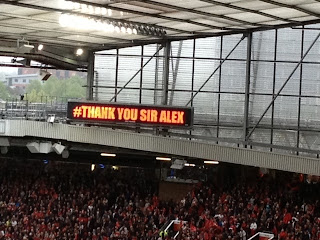
It was hardly surprising that Ferguson's retirement has provoked such strong emotions. This man, after all, has been responsible for some of the best moments of my life, from the Nou Camp to Moscow, from the Stadio Delle Alpi to Old Trafford. This man has caused me to travel the continent at great expense. But it has been worth it. Every single penny. Thank you Sir Alex.

Wednesday, February 13, 2013

Manchester United will hope to come up smelling of roses

Real Madrid - Manchester United: they don't come much bigger than this
Oh, how I love the smell of the city prior to hosting a Champions League clash of mammoth proportions.

OK so it is only the last 16 but I have not been this excited about a Champions League tie in years. Maybe not since the final in 2009. Sure, Manchester United made the final again in 2011 but noone truly believed they would prevail against Barcelona that night and those fears were realised as Messi, Iniesta, Xavi et al pummelled the Red Devils.

Tonight, however, represents a possible step towards redemption and a tantalising prospect at a fourth European Cup. Of course, there would still be the Catalan obstacle but this United side are significantly better than the one well beaten two years ago at Wembley. In addition, the belief that a victory over Madrid would provide could help them go on to lift the cup with the big ears once more.

As for the game itself, a nil nil would represent a good result to take back to Manchester, despite all the fears that a lack of an away goal would provide. More often than not, the away team ends up going through after such a result, though the memories of Monaco '98 and Madrid in 2000, where United ended up with a goalless draw, still bring back a feeling of dread as United crashed out.

However, given the porous defences on show a nil nil draw is about as likely as an imminent end to the financial crisis here in Spain.

2-1 to Los Blancos is this observer's prediction, which would still give Sir Alex Ferguson something to cling onto ahead of the return at Old Trafford next month.

Ferguson's line up is even harder to predict than the score but here goes. De Gea, Rafael Rio Evans Evra, Jones Carrick Cleverley, Valencia Van Persie Rooney.

This is not the most attacking of line ups which is the norm for United in Europe against heavyweight opposition. This formation could even morph into a 4-4-2 with Tom Cleverley and Phil Jones moving out to the wide midfield slots. The clearest advantage to this line up would be, effectively, three players being available to help quell the threat of Cristiano Ronaldo (Jones and Cleverley abley abetted by Valencia). Furthermore, Rooney maybe designated with the job of pressurising Alonso, when in possession, in a way not too dissimilar to the job Mario Goetze unselfishly performed in Dortmund's impressive results against Real.

The trouble is, these tactics will neglect the threat offered by Karim Benzema, Mesut Ozil and Angel di Maria. Furthermore, they will inevitably negate any attacking threat that United have of their own, though the possibility of pinching a goal always remain when matchwinners like Robin van Persie and Rooney himself remain on the pitch.

No doubt Jose Mourinho will have some tricks up his sleeve but it is the selction of his opposite number that is of greater intrigue.

Such negative tactics or not, nothing can quell the sense of anticipation I have in the pit of my stomach right now.

Monday, September 3, 2012

The Premier League as I see it

If Arsenal can keep their players fit they will comfortably qualify for the Champions League, and may even be closer to the top than many people expect. Cazorla looks like an excellent signing.

Kagawa looks like a decent signing for United, too, but it epitomises the Glazer era as Hazard is the real deal and I suspect he will have a similar effect on the Premier League as Henry or Ronaldo. Not so much in terms of goalscoring, though I still expect him to score 20 plus goals a season, but his overall effect in that he will be rated as the league's top performer year in year out. He is who wUmited should've signed this summer. With him and Van Persie they could've made a realistic challenge for the Champions League. As it is, Fergie's men are still a fair bit behind Real and Barca but, as Chelsea proved, it is a cup competition so you never know.

I think the signing of Maicon is sound business on City's behalf, though a centre half like Agger would've been even more help as I still see Lescott as their weak link in an otherwise impressive line up.

Talking of weak links, I see Di Matteo as Chelsea's. I think he's a good manager but is he capable of winning a Premier League? I have my doubts. Plus, Chelsea have an impressive squad up until you look at their striking options. If Torres gets injured, and he has a tendency to do so, they will struggle.

Tottenham should end up fifth with Everton nearby but neither will be troubling the top four.

As for the bottom of the table, I fear for Norwich, second season syndrome and all that, aligned with the loss of their manager, Paul Lambert.

Reading will struggle too, unlike the other promoted sides who have invested heavily.

The final relegation place is much more difficult to predict but I am going to go for one really left-field: Stoke. Just not sure how much longer Tony Pulis's magic can continue to work at the Britannia Stadium.

A belated set of predictions, I realise, but I am just putting it out there.

1st: Manchester City
2nd: Manchester United
3rd: Chelsea
4th: Arsenal
5th: Tottenham Hotspur
6th: Everton
7th: Liverpool
8th: Newcastle United
9th: Sunderland
10th: Aston Villa
11th: Fulham
12th: Wigan Athletic
13th: Queens Park Rangers
14th: West Bromwich Albion
15th: Swansea
16th: West Ham United
17th: Southampton
18th: Stoke City
19th: Norwich City
20th: Reading

Disclaimer: from tenth downwards is a bit of a lottery

Wednesday, March 21, 2012

8. Scotland in the sun: How La Liga’s problems are more than just skin deep

And now?

Spanish football is in turmoil. In March 2011 six clubs threatened strike action due to a dispute with the government over free-to-air television matches, in addition to the dissatisfaction with the widespread broadcasting deal dispute. The latest vice-president of the LFP resigned as a result.

The current president, Jose Luis Astiazaran, is under pressure to quit and Javier Tebas, the former vice-president, described him as “lacking leadership”.

Though Tebas says he has enough on his plate, he is not ruling out the possibility of one day taking over from Astiazaran as the head of the LFP: “I have enough problems, this is not on my agenda. (But) It is an option. You cannot throw these options away.”

Tebas believes no other country in world football has as much political in-fighting as Spain and that he sees no end to this. He said: “There will always be conflict between the clubs and the governing body and these problems are unique to Spain.”

The problem lies mainly in that all the power lies with Barcelona and Real Madrid. The rest are nowhere. Not just the other clubs, but the governing bodies too.

Some improvements are on the way as Tebas confirmed: “Right now they (Barcelona and Real Madrid) are getting 49% of the overall money from television.” The other eighteen clubs share the remaining 51%. “But there’s an agreement in place with them (Barca and Real) to reduce that 49% share to 34%. The smaller clubs have signed this with Barcelona and Real Madrid.” Nevertheless, this new arrangement is still three years away from taking hold.

Moreover, Spanish football writer Sid Lowe is not convinced it is a done deal. He said: “It's a proposal at the moment, not yet tied as I understand it.“

The Premier League offer ‘parachute’ payments to relegated clubs as a way of softening the financial blow that comes from not being in the top division. Tebas’ latest work has been arranging a similar proposition in Spain, using the 15% of television money generated from the newly devised deal.

This, Tebas says, is vital for those clubs as without it they could go out of business. “This is important as the money will help prevent them from disappearing.”

But it is not enough. Currently in England the top clubs, like Manchester United and Chelsea, enjoy approximately an 11% share (between them) from the Premier League’s television deal with Sky, ESPN the BBC. Wolverhampton Wanderers and Blackpool, for example, enjoy the same percentage from that deal.

The Bundesliga operates in a similar way to the Premier League where the governing body deal with the television companies, rather than the clubs on an individual basis.

Tebas is hopeful that this will one day be the case in Spain.

However, if the status quo remains, and clubs such as Barca and Real can negotiate their own deal, then there could be big trouble for the other clubs in Spain, and we are not just talking about your Malagas and Real Sociedads. Valencia, Spain’s third most successful club since the turn of the millennium, are in dire straits due to the financial downturn and an inability to move to a new stadium.

Imagine Arsenal, England’s third most successful club, facing a similar fate and it gives Valencia’s plight some context.

Tebas would not commit to naming Valencia as a club he feared for but clearly they were at the forefront of his mind when asked about the next five years. “I’m not going to identify a particular club but there are certain clubs that could disappear.”

So, not necessarily Valencia, but a team of similar ilk could cease to exist? “Yes, yes, yes,” came the unequivocal response. “That level of team, there is the possibility it could disappear,” Tebas added.

These are harrowing words, not least because they come from someone in such an esteemed position, but also because there are so few who have such a vantage point with which to judge.

There are more clubs in administration in Spain than there are in England. Sid Lowe expanded upon this: “Over the last few years a huge number of clubs have ended up in administration. Real Sociedad, Celta Vigo, Real Vallecano.”

La Liga has to change, and it has to change soon, before it finds itself, and some of its member clubs, staring into the abyss.

Saturday, March 17, 2012

7. Scotland in the sun: How La Liga’s problems are more than just skin deep

La Liga is in fine fettle - the arguments against

There is, of course, a strong case to suggest there is no need to be concerned about the health of the Spanish league.

For a start, Javier Tebas stated that he is confident of a resolution to the television deal. Currently, Real and Barca enjoy a 49% share of the money from broadcasting, although Tebas is optimistic that their portion will diminish to 34% by the 2014/15 season.

Tebas said: “We’re working towards a similar situation to that in England.”

In England the governing body, the Premier League, deal with the money from broadcasting rights and then distribute the monies in a more even manner. “In three or four years it will be like that in Spain,” Tebas affirmed.

Mind you, Tebas would say that. No lawyer would admit to having little chance of winning his case. Acknowledging the chances of victory are slim would only hinder his argument.

The former LFP vice-president also claimed that this period of dominance from the big two is nothing new. Historically, they are Spain’s two most successful clubs with 51 La Liga titles between them.

Tebas said: “It’s been 60 years that these two clubs have been at the top in Spain so it is not just because of the television money. Even throughout these years there have been occasions when the competition has been good and that someone else (other than the big two) have been at the top.”

Their supremacy is nothing new, but the distance between them and the rest has reached an unprecedented level. Never has the gap been so wide and it is showing no signs of abating. In the 2009/10 season they both recorded a record points haul and last season was more of the same.

In addition, they both reached the last four of the Champions League and, arguably, would have met in the final had they been kept apart in the draw. Of the three major trophies on offer to the top Spanish clubs (the Champions League, the Copa del Rey and La Liga), all ended up in the hands of Barcelona or Real Madrid.

Phil Ball, author of Morbo: the story of Spanish football, argues that Tebas will succeed as the rest of Spanish football demands it and, therefore, Barca and Real will have to respond to that demand. In turn, the fans will demand it too.

He said: “I think Tebas is right. In three or four years from now the money from television will be more evenly spread.

“Barca and Madrid can argue that, given that they generate all this (TV) money anyway, that they should have that amount (49%) of the pie. (But) I don’t see how you can sustain that argument over a long period because if the league continues, if the bridge continues (to widen), then by the nature of logic the league becomes less competitive and it messes up those who are at the top of it – Barca and Madrid. In the end they have a vested interest in the league being competitive.”

This would ring true in most other countries but in Spain things are a little different. Not least because the fans tolerate the dominance of the big two far more than in any other country due to what has been termed ‘second club syndrome’. This is where many Spaniards support one of Real or Barca in addition to their local club. And this devotion is evenly split which enables them to tolerate the lack of competitiveness within La Liga.

When asked to confirm the theory of ‘second club syndrome’, Grimsby fan Ball concedes: “That’s an interesting point. I had not thought of it like that because that’s definitely true. You can go to any pueblo (small town) in Spain and knock on the door and say: ‘who do you support – Barca or Real?’ and they’ll give you an answer. And the answer they give you is not always football based. It is a political, cultural answer. A lot of Spanish people won’t accept this argument but a lot of them do.”

Ball recognises that things have changed in recent years. He added: “Since the whole ‘galactico’ thing at the beginning of the century the face of Spanish football has changed. It was never like this (the gap between the big two and the rest) before. There was a feeling of democracy before but not now. You’ve got a three-tier league. There’s Barca, Real. Then there are those teams who aspire to reach the Champions League placings. Then there’s the rest.”

There is an equally strong argument that suggests it is just two tiers – Barca/Real and the rest. It is more conceivable that any of the other eighteen Primera Liga clubs reach a Champions League spot (finish in the top four) than it is that Real or Barca fail to finish in the top two. This is quite a statement. Could you imagine Norwich City or Wigan Athletic qualifying for the world’s most prestigious club competition? No? Well this illustrates just how unlikely it is that Barca or Real will finish outside the top two this coming season and for the foreseeable future.

Tebas argues that it is only the last two years. More importantly, he adds, Barcelona are dominating with an exceptional team that has been made largely through an astonishingly successful youth scheme and good management, not through spending huge amounts of money on transfer fees.

He said: “Looking at Barca, their big stars were not bought, they were made in Barcelona.”

However, this is ignoring the massive signing on fees Barca pay and a world record in the history of sport on wages.

For the first time in history a football team, or make that two football teams, have topped such a list. The average wage for a first team player at the Nou Camp is £4.94m annually, and at Madrid £4.6m. The average Yankee earns £4.2m a year. So it is not just impeccable grooming that keeps Barcelona on top.

Finally, Barcelona crushed Manchester United at Wembley this year to be crowned Kings of Europe. Surely this augments the belief that Spanish football is in rude health.

However, Pep Guardiola is constantly linked with a move to English football due to a craving for the competitive nature of the football and Mourinho regularly refers to the Premier League in wistful tones. In addition, Arsene Wenger urged Cesc Fabregas to ignore the overtures of the Spanish giants if he is a competitive footballer.

Monday, February 20, 2012

3. Scotland in the sun: How La Liga’s problems are more than just skin deep

Financial Matters
 
Spain has never had more people unemployed. Currently, that figure stands at five million.

Even Latin Americans who moved to the Iberian peninsular in search of work are seemingly desperate to return home, much like the Polish exodus from English shores in the last couple of years.

Government ministers insist it has reached a peak and that it won’t get any worse but the people of Spain are not convinced.

Football mirrors these troubles.

Spanish football writer Sid Lowe wrote on the website cbc.ca in 2010:

Luis Manuel Rubiales, the new president of the Spanish players union, the AFE, explained that 85 per cent of footballers in Spain's top three divisions either get paid late or not at all. Then there's the fact that the Spanish Football Federation, the RFEF, still owes the AFE €8 million.

According to Rubiales's predecessor, €100 million are still owed to footballers in unpaid wages.
The situation, Rubiales said, is the worst it has ever been.

Spanish football is in crisis according to José María Gay, Spain's leading expert on football finance and an adviser to Uefa: "La Liga is dying."

The Osasuna president, Patxi Izco, admits: "I fear a financial meltdown."

"Football," insists another director, "is seriously ill."

Real Madrid were saved from the threat of bankruptcy a few years ago only when the municipality of Madrid agreed to pay a large sum for the land on which their training ground sat.

The fact that the Spanish government and the country’s banks have helped Real is greeted with little more than a sigh from the other clubs in Spain. Can you really imagine the outcry in England if the government helped Manchester United stay on top or Barclays, at their customers’ expense, came in to rescue Liverpool from the oblivion of relegation? How would fans of Portsmouth, Leeds United and Southampton react to such news? These last three clubs have had to bite the bullet and accept their fate as they slid down the divisions due to the enforced sale of their best players, enabling them to stay in business. Manchester United would be expected to do the same. The Spanish government, seeing a similar fate bestowed on its most famous club, bought their training ground.

In England such actions are treated with a mixture of suspicion and bemusement. In Iberia, and perhaps throughout the Latin countries, it is treated as the norm.

Sid Lowe argues that it was in the country’s interests to help Real Madrid in their time of need, though he concedes it was not without some underhand tactics.

He said: "Institutional support in Spain is relatively normal but Real Madrid would argue the support is reciprocated as they do a lot of work for the community in terms of tourism and image. They would also argue that as the club represents the community they should get support."

And what about the deal whereby Madrid sold their training ground to the local government only to get it back again? "This is the big bone of contention. Real Madrid will say that the council got a good deal in terms of what they paid but it was Florentino Perez (the club President) who enabled the deal to happen. He, with the government, re-classified the land so that it was apt for construction.

"Perez is a construction magnate whose contacts are very strong in local government. This kind of tactic, though, is relatively normal. It has been used before and it will no doubt be used again."

Barcelona are not without their own problems on a financial front. Last summer they were late in paying the players’ wages and had to take out an emergency loan to help alleviate their difficulties in meeting their wage bill.

Sports lawyer Javier Tebas believed neither case was comparable to the troubles at the smaller clubs. "Barcelona and Real are a money making machine. They don’t have significant problems," he said. "Certain newspapers eight years ago said Real Madrid were going to go bankrupt and look at them now."

Well, with the government’s help and the aid of Madrid’s banks is it any wonder they survived?

"It was a help,” Tebas agreed, with a gesture suggesting inverted commas when he said ‘help’. "But with the help the competition can become distorted," he admitted

"The problem is not just that the big two have a greater budget than the rest," Tebas explains. "It is that all the other clubs have a lot of debt. There some smaller clubs where the interest repayments on their debts alone could pay for the salaries of Lionel Messis and Cristiano Ronaldo combined." In other words, 15 million in interest.
 

Thursday, April 9, 2009

Miss-firing squad

It's a squad game these days someone once said. And Sir Alex Ferguson recently proclaimed this current squad to be his best ever. Better than the double winning squad of '94. Better even than the treble winners of '99. So, that being the case, where is it all going wrong?

The answer has been presumed that Sir Alex's confidence was miss-placed. However, perhaps the real answer lies in the fact that it is not necessarily a squad game. First elevens do actually win the trophies and not the reserves.

A lot is about timing it to perfection and in terms of having your first eleven available at the crucial time of the season when the wheat and the chaff are separated.

Just take last season, for example, both Manchester United and Chelsea had their first teams available and their benches were without absentees either. Memorably Park Ji Sung couldn't make the bench as even Louis Saha managed to put on a tracksuit without pulling a hamstring. The same could be said for Manchester United's final league game when their whole squad was available.


Then imagine that final last May without Ronaldo or Ferdinand or even Wes Brown. Would they have emerged triumphant?


Many talk about a lack of depth in Liverpool's squad this season, citing the fact that they can't cope in Gerrard or Torres' absence but there is no way Manchester United would win a significant trophy were there to be a prolonged absence for Rooney or Ronaldo.


The sooner the Red Devils can get their big guns back fit - Ferdinand, Brown (yes, he's a big gun), Berbatov - and their big guns who have been miss-firing - Ronaldo, Carrick, Vidic, Evra - back on form the better and perhaps Man Utd's season can be rescued.


I have a hunch that Wednesday night's return in Porto may see one of those special European performances to rival that of Roma at home in 2007 or Barcelona away in 1998 but I also had a hunch that Roy Evans would deliver Liverpool's first league for many years back in 1997... and they are still waiting.