Pages

Total Pageviews

Thursday, June 17, 2010

World Cup musings - Swiss illustrate perfect timing as Zurich awakes from its slumber

As we waited for this World Cup to come alive, little did we expect a Manchester City reject to provide the fillip this tournament was in desperate need of, scoring the winning goal in Switzerland's 1-0 win over Spain.

A similarly profound effect was had on the city of Zurich, Switzerland's largest city. The Swiss, not known for their wild partying antics (when FC Zurich beat AC Milan in last season's Champions League a polite ripple of applause could be heard throughout Zurich), took to the streets to 'party'.

When Swiss people go crazy it generally constitutes a second piece of chocolate or a little less lemonade in their panache (shandy).

However, Wednesday's result in Durban created something on a much grander scale. Langstrasse, a street famous for lap dancing joints and home to some of Zurich's dodgiest bars, was closed for several hours as people drank copious amounts of alcohol, waved the national flag and danced on the rooftops of cars.

Zurich hasn't seen this kind of commotion since Tina Turner opened a bank account here.

Now, to say the Swiss were going crazy on the aforementioned street might be being a bit flexible with the truth as, admittedly, most who were seen hooting horns (not the first time someone got the horn on this street, eh?!), drinking beer and waving the flags ferociously, were either Turkish or Latin American. However, this was punctuated with the odd smiley Swiss face, often painted in the national colours of red and white.

Even the local media got caught up in the excitement of it all. The Blick described the result as 'The miracle of Durban' and the nation was in a state of 'Jubilation', which has to be a first.

The reaction was as if they had actually won the whole damn thing but that is understandable as the locals know this could be as near as they ever get to doing just that.

Sunday, June 13, 2010

World Cup musings - Capello culpable

England began their campaign in the way they begin most tournaments. Start the game well, but then fade and, at times, be grateful for the point that would have seriously disappointed them prior to the match.

The Three Lions generally start with eminently winnable games but then fluff their lines after a bright start.

Think Italia '90 against Ireland, Euro '96 v Switzerland or in Japan in 2002 against the Swedish. Now you can add USA in South Africa to that list.

The reasons for the failure to grab all three points are multiple but in each there is one common factor - Fabio Capello.

Take the most obvious disappointment from yesterday, the Robert Green blunder. Sure it was the West Ham goalkeeper's fault (I couldn't believe the way he held his hand up to admit blame, like his team-mates and the rest of the world needed to be told) but the decision to pick him was as inexplicable as the goal itself.

One of Capello's most perplexing statements was when he announced a year ago that he already knew who his number one would be in South Africa. At the time, that had to be David James as he was the man in possession of the number 1 jersey and Green had barely played for the national team.

Clearly the England manager had either been leading us up the garden path or changed his mind.

What baffles me even more, and did so at the time, was not to select the in-form Joe Hart for the friendly against Egypt in March, or for the full 90 minutes in any of the friendlies in May.

To throw Hart in against the United States for his full debut would have been a massive gamble. Yet had he played a few times already, we would have known if he was capable at this level or not. Surely his time has to come in the next game against Algeria.

The decision to select Milner was understandable but to replace him with Shaun Wright-Phillips was not. Joe Cole, who was one of the only England players to emerge with any credit from the last World Cup, was the obvious replacement.

Too many times Wright-Phillips mis-controlled the ball and the effort he had on goal mid-way through the second half was woeful.

But his performance hardly came as a surprise. Ever since the winger's debut under Sven Goran-Eriksson it has been clear that the weight of the England shirt hung heavy on his diminuitive frame.

Furthermore, he does not make the starting eleven for Manchester City, his place going to Michael Johnson. That Johnson did not make the squad and SWP did is another decision that makes little sense.

Then there is the Emile Heskey conundrum. Admittedly, he did well to set up Gerrard's opener but I'm sure Peter Crouch could have laid that ball on for the England captain to score. Then, when it came to Heskey's big moment, baring down on goal, he was left wanting, shooting straight into the grateful arms of Tim Howard.

I recognise we do not have many striking options (Heskey was 350/1 to be top scorer for the tournament and Japan have scored more goals for England than him in the last couple of years) but that leads me to my final point.

To make serious progress in this tournament we will have to play Rooney in his best position - at the top as an out and out striker. Too many times we see Rooney picking up the ball in the centre circle, too far from goal to do serious damage.

I recall Sir Alex Ferguson explaining that he played Rooney as a striker because he felt that was his best position, but also due to the fact that he had an abundance of good midfielders in his squad that he couldn't leave them out.

The same could be said of England. Our strength is in midfield and in terms of forwards, after Rooney we are struggling. I think in the group stage we should stick with 4-4-2 but when we come up against tougher opponents we have to play with Rooney up top and Gerrard in close support like he does for Torres at Liverpool.

The only problem I can envisage with this system is that it is not one we have played before. To not play this formation before is the final decision which could yet haunt Mr Capello.

Thursday, June 10, 2010

World Cup musings

With the sad news of Rio Ferdinand's enforced absence from the World Cup (following a tackle with Emile Heskey, of all people) I couldn't help but begin to wistfully think of absent friends.

Imagine an England squad with Rio in it, as well as Owen Hargreaves and Michael Owen, not to mention retiree Paul Scholes, then we would really have entered this tournament with real confidence.

As it is, a kind draw still makes the semi finals a distinct possibility but without our captain and a top quality holding midfielder, you would have to imagine a side like Brazil or Spain will knock us out (think back to England's friendlies against these two nations in 2009 when we were comfortably beaten and it paints a pretty bleak picture).

Still, where there is Wayne Rooney, there is hope.

Furthermore, England are not the only nation to be missing players through injury. Our old friends Germany, in particular, will suffer from the absence of Michael Ballack, Christian Traesch and number one goalkeeper Rene Adler.

Italy have severe doubts surrounding the influential midfielder Andrea Pirlo and then there is the Spanish. There must be severe doubts surrounding the durability of Cesc Fabregas, Fernando Torres and Andreas Iniseta after being out injured for significant parts of 2010.

Nevertheless, the 'golden generation' for England who gave us so much hope prior to the 2006 tournament still have one more shot at glory, albeit it minus David Beckham. For Frank Lampard, Steven Gerrard and possibly John Terry, this has to be their last chance at World Cup glory. If that is not enough motivation, then nothing will be.

Thursday, March 18, 2010

A Russian evolution, not revolution, is required at the Bridge

When a football team loses a big game they are in need of a re-vamp and the squad needs a major over-haul. When they win, they're the best in the world. That's the way football works, particularly in the eyes of fans and media alike.

Just hours after Manchester United's defeat at the hands of Barcelona in last year's Champions League Final, the national media were quick to point out the necessary surgery on Sir Alex Ferguson's squad, despite the fact that they were the second best team in Europe and had picked up three trophies, including a third successive league title.

Following Chelsea's departure from the Champions League this week after losing to Inter the obituaries have once more been written once more.

Carlo Ancelotti faces the chop according to the Daily Mail. Chelsea players are to receive same fate say The Times.

Well, I think some perspective is needed. Chelsea have just lost to one of the best teams in Europe and they were without three key components that would surely have made a significant difference to the outcome - Petr Cech, Ashley Cole, Michael Essien.

Take away Julio Cesar, Maicon and Wesley Sneijder from Inter and see how they would cope with Europe's elite. Apply the same strategy to Manchester United with Edwin van der Sar, Patrice Evra and Darren Fletcher and the Red Devils would not have swatted AC Milan aside with such ease, in spite of Wayne Rooney's heroics.

Even the all-conquering Barcelona would struggle without Victor Valdes, Dani Alves and Xavi.

While the panic buttons may be being pressed amongst the Chelsea faithful surely Roman Abramovich has learnt the lessons of changing the manager following four managers in less than three years since Jose Mourinho's accrimonious departure. These changes have hardly helped as they have one just one FA Cup in that period, as Mourinho proudly pointed out at his press conference this week.

What Chelsea require is an injection of youth, but possibly just one or two players. Maybe a centre half, to ease the burden on John Terry and Ricardo Carvalho, and a wide player/striker to re-invigorate the forward line.

Let's not forget, they still have one of the best strikers in the world in Didier Drogba and he should be persisted with for at least one more year, but clearly his partnership with Nicolas Anelka does not work against the top sides in Europe and the Blues should revert to the policy of playing him up front alone on occasions such as Tuesday night.

Furthermore, Ancelotti deserves more time to impose his ideas, particularly as he has not been given the money that his predecessors have had at their disposal.

Food for thought for the Chelsea hierarchy, but a feast of changes may not be the answer.

Friday, November 13, 2009

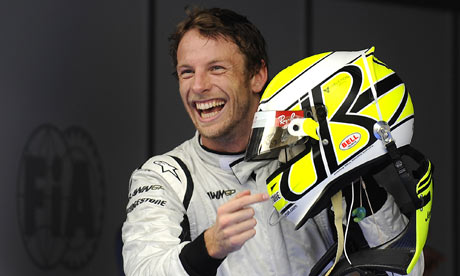
Button goes in reverse to realise a dream


June 7, 2009: Barcelona had just been crowned Champions of Europe, Michael Jackson was rehearsing for his 'This is it tour' and Swine Flu was on the verge of being announced as a global pandemic.

It is also the date that Jenson Button was last victorious in a Formula One race, ten races ago, at the Turkish grand prix.

This statistic would not be so astonishing were it not for the fact that the boy from Frome, Somerset, went on to become world champion.

The season went from one low points finish to another but it mattered little as his rivals put up little fight and he was crowned champion with a race to spare.

In fact, Jenson only finished higher than fifth on one occasion between that victory in Istanbul and clinching the title in Sao Paulo, Brazil five months later.

A worthy champion ?

Before this season there was nothing to suggest Button would ever become an F1 world champion; and since that fifth place finish at Interlagos two weeks ago many have asked the whether Button is a worthy champion. In a word: "no".

Don't get me wrong, he's a nice guy and a talented Formula One driver but it takes so much more to be deemed a rightful F1 world champion.

In living memory it is difficult to think of a less deserving champion than the former Williams and Honda driver.

Here is a list of recent Formula One champions: Hamilton, Raikkonen, Alonso, Schumacher, Hakkinen.

Button is not even fit to tie their shoelaces; even the much-maligned Damon Hill was a serial title threat and had to withstand immense pressure to eventually wrap up his title in 1996 at the season finale at Suzuka, Japan.

Impressive debut

He made his debut amid much fanfare in the year 2000 and made an impressive start to his career with the Williams team, managing to out-perform his more experienced team-mate Ralf Schumacher.

However, the Englishman went on to spend eight largely unsuccessful seasons meandering around some of the worlds most famous race tracks, barely unsettling the established order.

Nevertheless, he did win his maiden grand prix in 2006, in Hungary, but it took him 113 races to reach this milestone and he seemed certain to be consigned to the history books as a mere race winner and not a champion.

That was until a remarkable change of luck at the beginning of this season.

Changing the rules

A dramatic change of the rules, which at the time were described as some of the biggest the sport had ever seen, within Formula One, saw the newly formed Brawn team come up with an ingenious technical advantage.

The chassis of their car gave them an immediate and substantial advantage over their rivals, at least for the first few races of the season, whilst the other teams adapted much more slowly to these new regulations.

Ferrari and McLaren had dropped the ball and were left languishing down the field, which aided the team Brawn effort.

All this fortune meant that a driver whose career was going nowhere was now in a car so far ahead of the rest that it was almost impossible not to win races.

No competition

Button's other stroke of luck was that his team-mate was another Formula One also-ran, Rubens Barrichello, who, like the Briton, took more than 100 races to win a grand prix.

To the 29-year-old's credit he took full advantage and won six of the first seven races whilst his car was so much better than the competition.

But that sixth victory proved to be his last of the season and he ended up winning the title more through the fact that his competitors were left tripping over themselves or that the best drivers on the grid; Fernando Alonso, Lewis Hamilton, Kimi Raikkonen and Sebastian Vettel were all in inferior machinery.

So the man from Somerset effectively reversed into winning this year's title, but what about the style in which he achieved his success.

Lacklustre champion

I spoke to Gemma Briggs, The Guardian's weekly Formula One columnist, about Button's recent title win. who said: “He's not a worthy champion. Not at all.''

She continued: “Not just because of his lack of victories in the latter stages of the season but for me he lacks the aggression of a true champion.

“When you compare him to other champions there was a distinct lack of fireworks as he won his world championship in a somewhat lacklustre manner, particularly in comparison to last year's champion Lewis Hamilton who was always making things happen. Button, though, would, in his own serene way, just lead from the front or cruise and collect points in his efforts to win the title, lacking flamboyancy.”

And what of the future? Next year it is inevitable that McLaren and Ferrari will be much more on the pace and Brawn will have a fight on their hands to retain both the drivers and constructors titles they earned this year.

Tough enough?

A renaissance from the top teams is certain, but what is equally sure will be the motivation of the other drivers to topple Button from his lofty perch.

If he thought it was tough to cross the finish line first this year, things are just about to get even tougher.

When the going gets tough, it is difficult to know whether Button is tough enough to get tougher and any talk of a move to McLaren is likely to be much like the wind flying out of the rear of his engine- hot air.

So this season will almost certainly have been just a flash in the pan for Button and if he wins another world title, I will eat my exhaust pipe.